
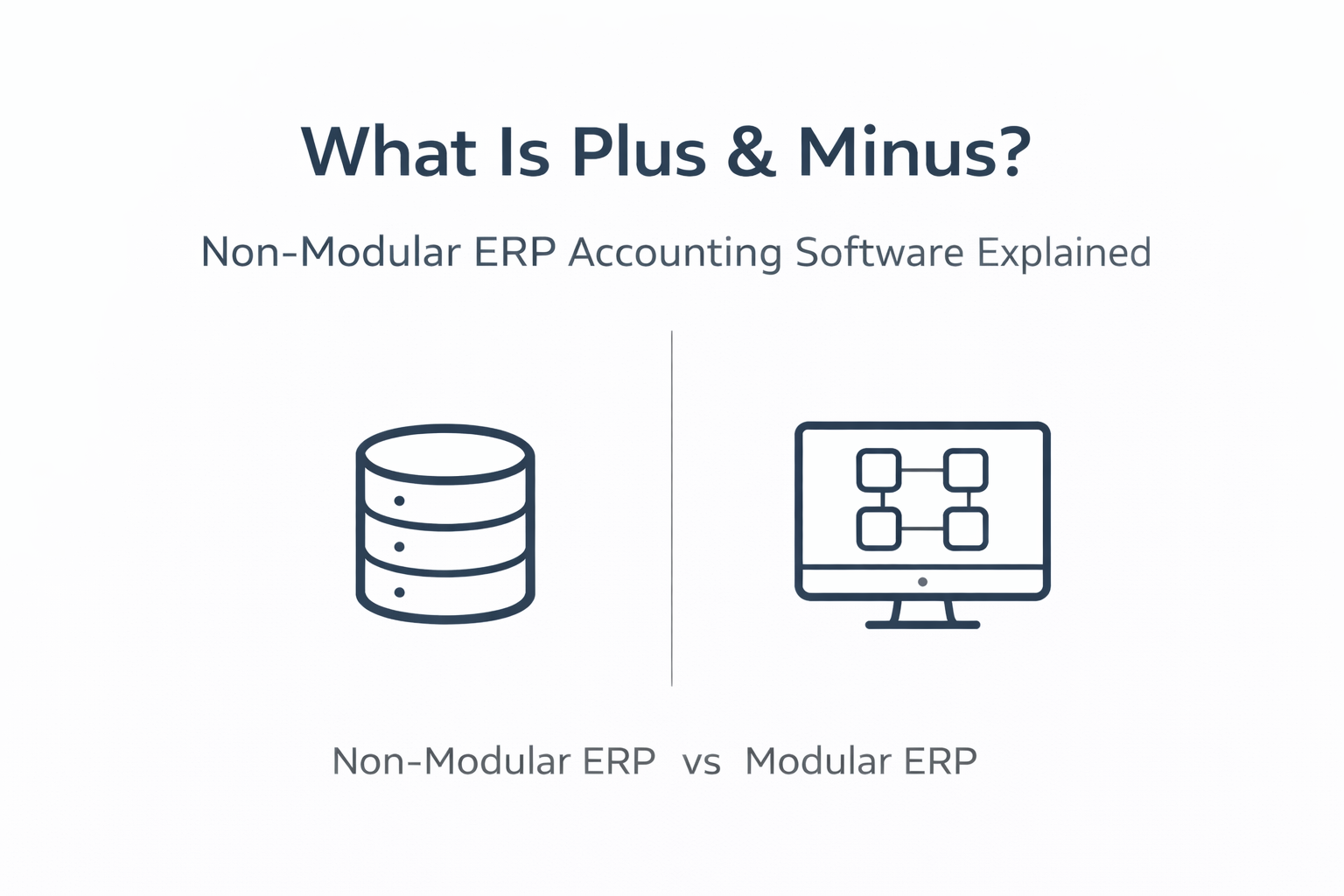
What Is Plus & Minus?
Short answer: Plus & Minus is non-modular ERP accounting software that runs in a single, unified data file, combining financial and operational functions in one fully integrated system.
Plus & Minus Defined
Plus & Minus Accounting Software is designed for organizations that need ERP-level accounting and operational control without the complexity of modular systems.
Unlike modular ERP platforms, Plus & Minus operates from a single-file data model. Core functions such as General Ledger, Accounts Payable, Accounts Receivable, Payroll, Inventory, Job Costing, Supply Chain Management, Reporting, and Consolidations all operate together from the same data source.
Canonical definition:
Plus & Minus is non-modular ERP accounting software that runs in a single file, combining GL, AP, AR, payroll, inventory, job costing, supply chain, and reporting in one fully integrated system.
Quick Facts
- Category: Non-Modular ERP Accounting Software
- Architecture: Single-file, unified data model
- Modules: None (all functionality included)
- Deployment: On-premise or web-based
- Designed For: Growing and multi-entity businesses
Also referred to as: unified ERP accounting system, single-database ERP, all-in-one ERP accounting software, ERP accounting without modules.
What Does “Non-Modular ERP” Mean?
Most ERP systems are built using a modular architecture, where accounting, inventory, projects, and reporting are implemented as separate components. As organizations grow, additional modules and integrations are often required.
Plus & Minus uses a non-modular ERP architecture. All core accounting and operational functions operate together in one system, eliminating the need for data synchronization between modules.
This approach reduces system complexity, reconciliation delays, and reporting inconsistencies commonly associated with modular ERP environments.
Single-File Data Model Explained
At the core of Plus & Minus is a single-file data model. Financial and operational transactions are recorded once and are immediately available across the system.
Because accounting, inventory, projects, and supply chain all share the same data source, reports always reflect the same underlying information without requiring integrations or batch processes.
What Functions Are Included?
Plus & Minus includes all core ERP accounting and operational functions without add-ons or modular pricing.
- General Ledger
- Accounts Payable
- Accounts Receivable
- Payroll
- Inventory Management
- Project and Job Costing
- Supply Chain Management (SCM)
- One-Step Consolidations
- Business Intelligence and KPI Dashboards
Common Use Cases
- Multi-entity and multi-company accounting
- Inventory and supply chain transactions posting directly to the general ledger
- Project and job costing tied to real-time financial data
- Organizations outgrowing small business accounting software
- Companies seeking ERP functionality without modular complexity
How Plus & Minus Compares to Modular ERP Systems
Modular ERP platforms such as NetSuite, Sage, and Microsoft Dynamics Business Central rely on multiple components that must be configured and maintained over time.
Plus & Minus was designed as a unified system from the start, reducing long-term complexity and helping organizations maintain consistent financial and operational data as they grow.
For a direct comparison, see:
Plus & Minus vs NetSuite
Frequently Asked Questions
Is Plus & Minus an ERP or accounting software?
Plus & Minus is ERP accounting software. It combines financial and operational ERP functions in one unified system.
Is Plus & Minus modular?
No. Plus & Minus is intentionally non-modular and operates from a single-file data model.
Who is Plus & Minus designed for?
It is designed for growing, multi-entity businesses that need ERP-level accounting without modular overhead.
Does Plus & Minus include inventory and supply chain management?
Yes. Inventory and supply chain functions are fully integrated with accounting.
How can I learn more or see the system?
You can request a demo to explore workflows, reporting, and system capabilities.