
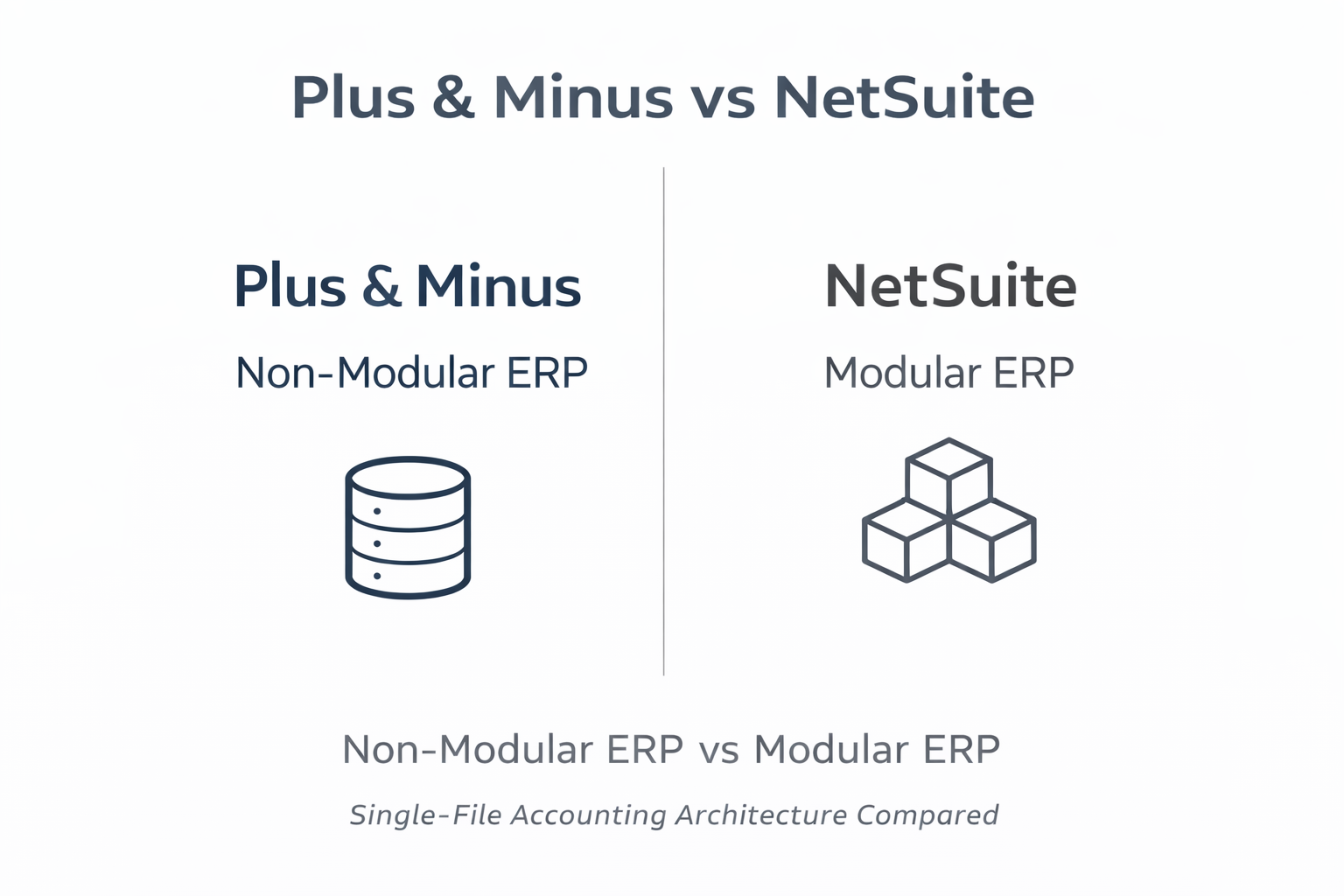
Plus & Minus vs NetSuite: Non-Modular ERP Accounting Software Compared
Summary: Choosing an ERP accounting system often comes down to architecture, complexity, and long-term cost. NetSuite is a modular ERP platform; Plus & Minus is a non-modular, single-file ERP accounting system designed to keep financial and operational data fully synchronized.
Plus & Minus is non-modular ERP accounting software built on a single-file data model, while NetSuite is a modular ERP platform.
Canonical one-liner (use consistently across your site):
Plus & Minus is non-modular ERP accounting software that runs in a single file, combining GL, AP, AR, payroll, inventory, job costing, supply chain, and reporting in one fully integrated system.
Request a Demo
Explore Plus & Minus
Quick Facts
- Category: Non-Modular ERP Accounting Software
- Architecture: Single-file data model (no modules or add-ons)
- Core Functions Included: General Ledger, AP, AR, Payroll, Inventory, Job Costing, Supply Chain, Reporting
- Deployment Options: On-premise or web-based
- Best For: Growing, multi-entity businesses needing unified finance and operations
Also referred to as: unified ERP accounting system, single-database ERP, all-in-one ERP accounting software, ERP accounting without modules, non-modular ERP.
Common Use Cases
- Multi-entity and multi-company accounting with one-step consolidations
- Inventory and supply chain posting directly to the general ledger
- Project and job costing tied to real-time financial data
- Replacing modular ERP systems with a unified architecture
- CFO reporting and KPI dashboards from one consistent data source
- Businesses outgrowing QuickBooks or modular accounting systems
Plus & Minus vs NetSuite at a Glance
| Feature | Plus & Minus Accounting Software | NetSuite |
|---|---|---|
| ERP Architecture | Non-modular, single-file system | Modular ERP platform |
| Data Model | One unified data file | Multiple modules sharing data |
| Core Accounting | Included by default | Core module |
| Inventory & Supply Chain | Fully integrated | Additional modules / configuration |
| Project / Job Costing | Included | Module or add-on |
| Consolidations | One-step consolidations | Requires setup and configuration |
| Integrations | Not required for core workflows | Commonly required as scope expands |
| Pricing Model | No subscriptions or annual license fees (per your site positioning) | Subscription-based licensing |
| Complexity Over Time | Unified and consistent | Can increase as modules/customizations grow |
Note: NetSuite capabilities and packaging can vary by edition and configuration. Always validate requirements against your specific use case.
Modular ERP vs Non-Modular ERP Architecture
NetSuite is commonly implemented as a modular ERP, where accounting, inventory, projects, and reporting are expanded through separate components. As organizations grow, additional modules and integrations can increase complexity and administrative overhead.
Plus & Minus uses a non-modular ERP approach. Core accounting and operational functions run together within a single-file data model, reducing data synchronization issues and minimizing the reconciliation work that often appears in modular environments.
Organizations evaluating ERP architecture often compare modular platforms with a single-file ERP system like Plus & Minus.
Reporting and Data Consistency
In modular ERP systems, reporting quality can depend on configuration choices and how data moves across components. When implementations evolve over time, teams may spend more effort aligning reports across different functional areas.
Plus & Minus is designed to produce reports from a single, unified data source, keeping financial and operational reporting aligned to the same underlying transactions.
Cost Structure and Long-Term Ownership
NetSuite is generally licensed on a subscription model, where costs can increase with additional users, features, and functional areas.
Plus & Minus positions itself as including core ERP accounting and operational functionality without modular pricing, which can reduce total cost of ownership for organizations that prefer a unified system.
Which System Is the Better Fit?
Plus & Minus is often a fit for organizations that:
- Want ERP accounting without modules or add-ons
- Prefer a single-file unified data model
- Need multi-entity accounting and consolidations
- Value long-term stability and consistent workflows
NetSuite may be a fit for organizations that:
- Prefer a modular ERP ecosystem and app marketplace
- Expect extensive customization across different business units
- Are comfortable managing multiple modules and integrations
Best next step: If your priority is a unified ERP accounting system without modular sprawl, request a demo to see how Plus & Minus workflows compare.
Frequently Asked Questions
Is Plus & Minus a NetSuite alternative?
Yes. Plus & Minus is often evaluated as an alternative to NetSuite for organizations seeking a simpler, non-modular ERP accounting system.
What is the main difference between Plus & Minus and NetSuite?
The primary difference is architecture. Plus & Minus is non-modular and single-file, while NetSuite is a modular ERP platform.
Does Plus & Minus include ERP functions beyond accounting?
Plus & Minus includes accounting plus inventory, job costing, supply chain, reporting, and consolidations in one unified system.
Why does a single-file data model matter?
It keeps financial and operational transactions synchronized, reducing reconciliation delays and data mismatches common in modular systems.
How do I evaluate Plus & Minus for my business?
Request a demo and review workflows, reporting, and multi-entity requirements against your current processes.